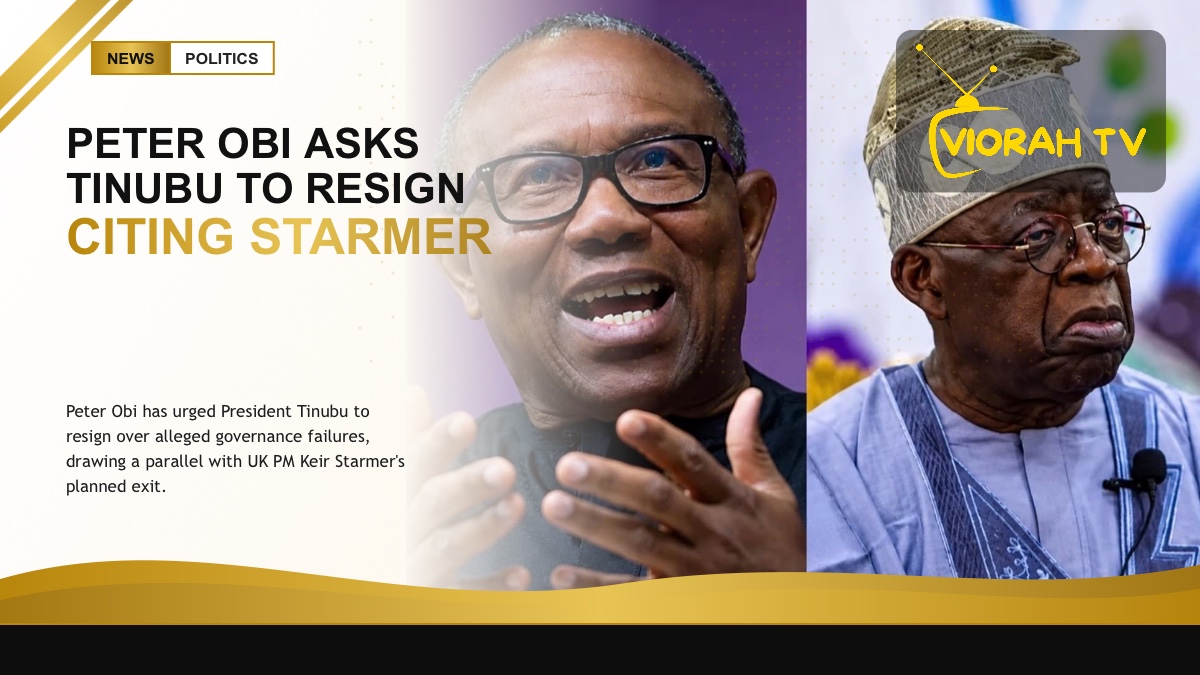
Former Labour Party presidential candidate Peter Obi has called on President Bola Tinubu to resign, citing what he described as worsening governance, insecurity and economic hardship. Peter Obi said his appeal was prompted by developments in the United Kingdom, where Prime Minister Keir Starmer announced plans to step down amid mounting public frustration.
What Peter Obi said
Obi argued that the conditions driving political accountability abroad were also present in Nigeria, pointing to a high cost of living, unreliable power supply and rising insecurity. He suggested that leaders should accept responsibility when key promises go unmet, and held up the UK situation as an example. The remarks quickly spread across Nigerian social and political circles, drawing both support and criticism.
The promises he referenced
Obi recalled that during the 2023 campaign, Tinubu made several pledges, including improved electricity, stronger anti-corruption efforts and better welfare, and had urged voters not to re-elect him if he failed to deliver. According to Obi, those conditions have worsened rather than improved. The government has previously defended its record, citing reforms it says will yield results over time.
A historical parallel
Obi also noted that, before the 2015 election, Tinubu himself had repeatedly called on then-President Goodluck Jonathan to resign over insecurity and hardship, including during the Chibok kidnapping. By drawing that comparison, Obi sought to frame his demand as consistent with arguments Tinubu once made. The reference added a pointed edge to an already charged political exchange.
Why it matters
Calls for resignation rarely change a sitting government directly, but they shape the political conversation ahead of future elections. Obi remains an influential opposition figure, and his interventions tend to galvanise debate. Viorah TV is reporting his comments as made, and takes no position on the claims or the government’s record, which supporters and critics continue to dispute.
The 2027 backdrop
Obi remains one of Nigeria’s most prominent opposition figures after a strong showing in the 2023 election, particularly among young, urban voters drawn to his message of prudent governance. His interventions tend to dominate headlines and energise his large online following, which is part of why a single statement can ripple so widely. Calls for a sitting president to resign are unusual in Nigeria and almost never lead to an actual departure, but they serve a political purpose, keeping pressure on the government and framing debate ahead of the next election cycle. The reference to the United Kingdom also reflects how global political events are increasingly invoked in Nigerian discourse, used as mirrors for domestic frustrations over the economy and security. Supporters of the president argue that reforms take time and that criticism ignores structural challenges inherited from the past, while opponents insist results should already be visible. That back-and-forth is likely to intensify as parties and personalities position themselves, with each side seeking to shape public expectations long before campaigning formally begins.
The demand adds to the early jostling around Nigeria’s political future. How the presidency and other parties respond will play out in the weeks ahead. Viorah TV will continue to follow the reactions.

