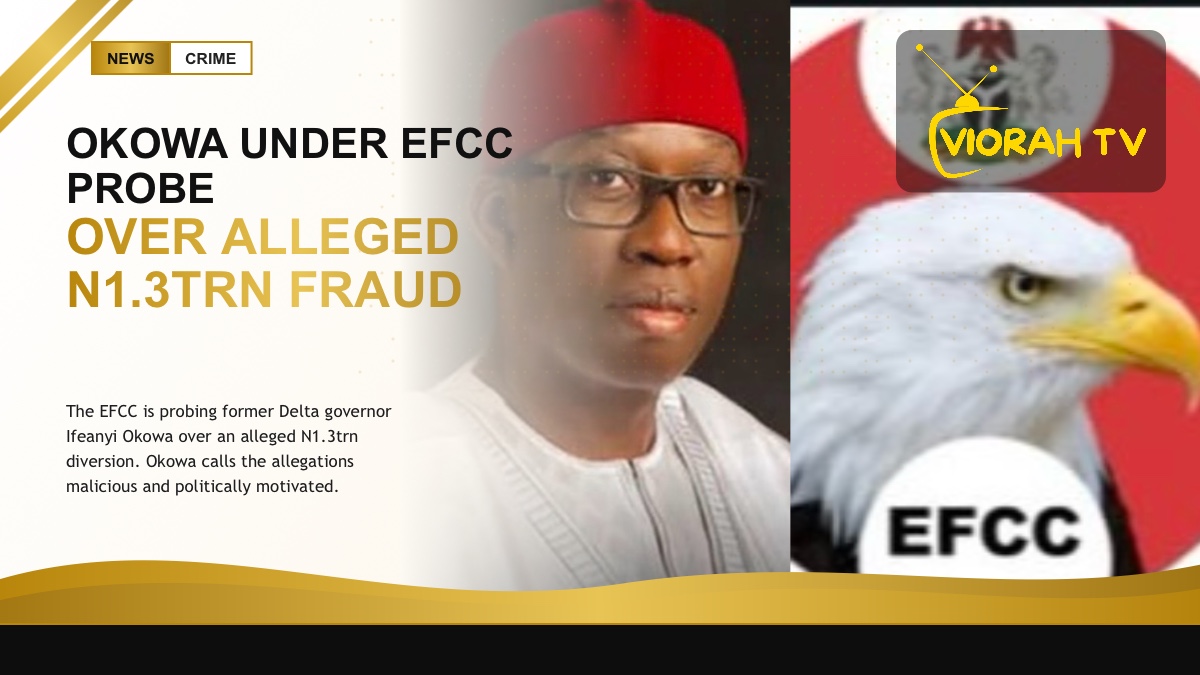
The Economic and Financial Crimes Commission is probing former Delta State governor Ifeanyi Okowa over an alleged diversion of N1.3 trillion. Okowa, who served two terms and was the Peoples Democratic Party vice-presidential candidate in 2023, has denied wrongdoing, describing the allegations as malicious and politically motivated.
What the EFCC alleges
According to the EFCC, the funds in question relate to the 13 percent derivation revenue allegedly diverted during Okowa’s tenure between 2015 and 2023. The commission has also pointed to an additional sum allegedly used to acquire shares in a gas venture, and is said to be examining property holdings. The agency confirmed Okowa reported to its office following a summons before being questioned.
Okowa’s response
Okowa has rejected the allegations, insisting they are unfounded and driven by politics rather than evidence. He has said he knows those behind the probe, framing the case as targeted. None of the allegations have been tested in court, and under Nigerian law they remain claims unless and until proven. Viorah TV is reporting the EFCC’s statements and Okowa’s denial without taking a side.
Probe continues despite defection
The EFCC has indicated that its investigation continues despite Okowa’s reported move from the PDP to the ruling All Progressives Congress. That detail has fuelled public debate, with some critics questioning whether political realignments affect anti-graft cases. The commission has maintained that the inquiry is proceeding on its own terms, independent of the former governor’s party affiliation.
Why it matters
High-profile corruption probes involving former governors are closely watched in Nigeria, where public trust in anti-graft efforts is often tested by perceptions of selectivity. The outcome of the Okowa case will be read against that backdrop. For now, the matter is at the investigative stage, and the presumption of innocence applies as the process unfolds.
Scrutiny of oil-state finances
The case centres partly on the 13 percent derivation revenue, the share of oil income constitutionally allocated to oil-producing states to address the impact of extraction. Because these funds are large and the oversight of their use has often been weak, former governors of oil-rich states frequently come under scrutiny once they leave office and lose immunity. The EFCC has pursued a number of such cases over the years, with mixed outcomes, and critics on all sides watch closely for signs of either genuine accountability or political selectivity. Supporters of robust anti-graft action argue that recovering diverted public funds is essential in a country where many citizens lack basic services, while defenders of those accused often point to the political timing of probes. In Okowa’s case, his denial and the framing of the allegations as politically motivated are familiar features of high-profile Nigerian corruption inquiries. The legal process, including any charges, trial and possible appeals, can take years, and the presumption of innocence remains central. How transparently the case proceeds will shape public confidence in the broader fight against corruption.
The case adds to a series of recent EFCC actions against current and former officials. Viorah TV will continue to follow the probe and report verified developments.

