Table of Contents
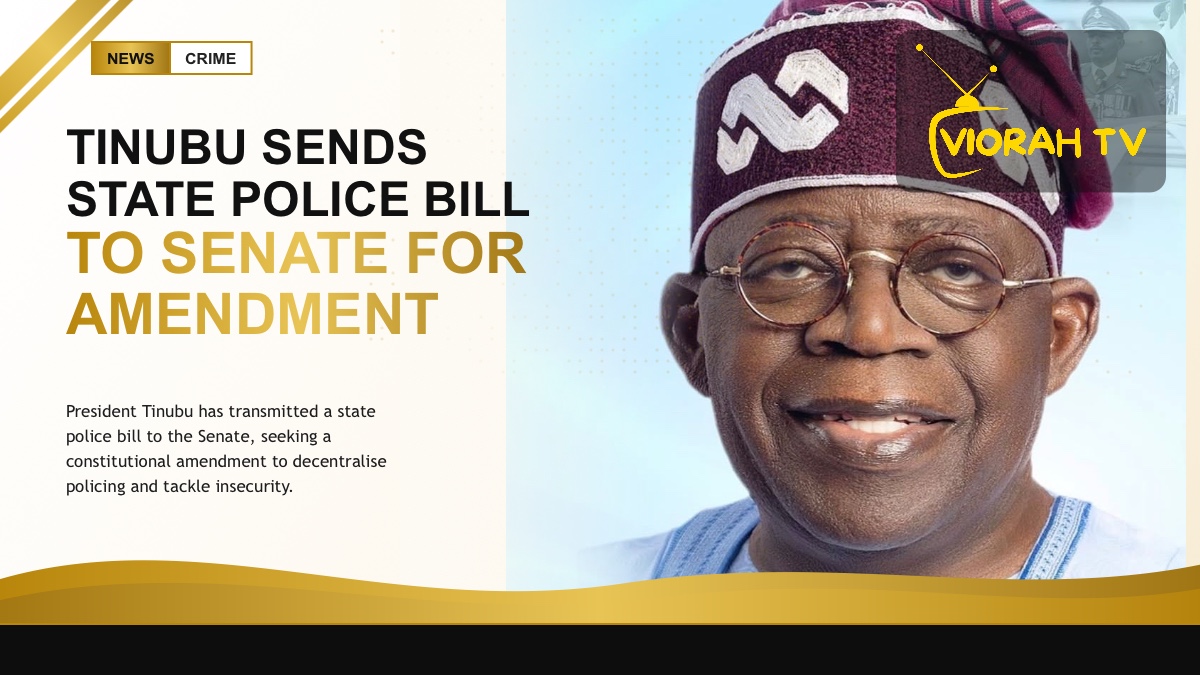
President Bola Tinubu has transmitted a state police bill to the Senate, seeking a constitutional amendment that would allow Nigeria’s 36 states to establish their own police forces as part of a wider push to reform the country’s security architecture.
What the state police bill proposes
The proposal, titled the Constitution of the Federal Republic of Nigeria (Alteration) State Police Bill, 2026, was contained in a letter dated June 15, 2026. Senate President Godswill Akpabio read it on the floor during plenary, informing lawmakers that debate on the measure would begin the following day.
If enacted, the bill would decentralise policing, which is currently controlled entirely at the federal level through the Nigeria Police Force. Supporters argue that state-run forces could respond faster to local threats such as kidnapping, banditry and communal violence.
Why the state police bill matters
Insecurity has remained one of the most pressing challenges facing the country, with attacks recorded across several regions. Tinubu has framed the reform as central to his administration’s strategy to reorganise Nigeria’s security framework so that it can better protect citizens.
Calls for state police have grown for years, with governors and security analysts arguing that a single, centrally commanded force struggles to cover a nation of more than 200 million people spread across vast and varied terrain. Critics, however, have raised concerns about funding, possible political misuse and the need for strong oversight.
The road to becoming law
Amending the constitution is a demanding process. Even if the National Assembly passes the bill, it would still require approval by at least two-thirds of the 36 State Houses of Assembly before it can take effect. That means the proposal faces a long path through both federal and state legislatures.
Lawmakers are expected to scrutinise the details closely, including how state forces would be funded, who would command them and how they would coordinate with the existing federal police. These questions are likely to shape the debate in the weeks ahead.
Reactions and next steps
The transmission of the bill signals that the executive is prepared to push the issue formally rather than leave it to public debate alone. By sending a draft directly to the Senate, the presidency has placed the matter squarely on the legislative agenda.
Stakeholders across the political spectrum are likely to weigh in, given how closely the topic touches on federalism, the balance of power between Abuja and the states, and everyday safety for ordinary Nigerians. Some governors have long championed the idea, while others remain cautious.
What to watch
Attention now turns to how senators receive the proposal and whether they fast-track or slow-walk the deliberations. The outcome will offer an early indication of the political appetite for one of the most significant security reforms proposed in recent years.
For citizens living with the daily reality of insecurity, the practical question is whether state police, if approved, would genuinely improve safety. That answer will depend not only on the law itself but on how carefully it is implemented and supervised.

