Table of Contents
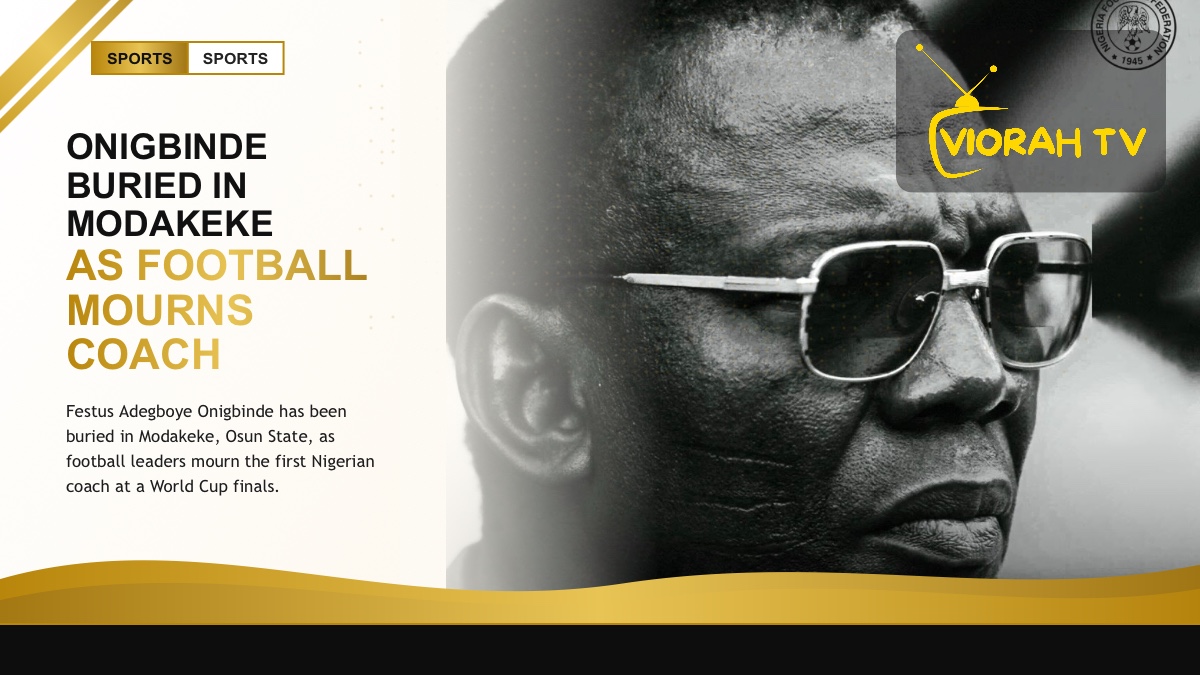
Festus Adegboye Onigbinde has been buried in Modakeke, Osun State, drawing football administrators, royal fathers and former internationals to mourn one of Nigeria’s most respected coaches.
The Gist
- Festus Onigbinde buried in Modakeke, Osun State
- First Nigerian coach at a World Cup finals
- Football leaders and royals mourn him
The former Super Eagles handler was laid to rest on Friday at St Stephen’s Cathedral, Modakeke. He died on 9 March 2026 at the Obafemi Awolowo University Teaching Hospital, Ile-Ife, aged 88.
The Nigeria Football Federation supported the funeral, and a stream of officials, ex-players and government representatives joined the family to pay their last respects.
Why Onigbinde was buried with national honours
Onigbinde was a pioneer. He became the first indigenous coach to lead Nigeria to an Africa Cup of Nations final and the first to take the Super Eagles to a FIFA World Cup.
Appointed in 1982, he guided the side to second place at the 1984 Africa Cup of Nations in Cote d’Ivoire, where they lost 3-1 to Cameroon in the final.
Years later he returned to the dugout and led Nigeria at the 2002 World Cup in South Korea and Japan, cementing his place in the country’s football history.
That World Cup campaign was tough, drawn in a group with Argentina, England and Sweden. Yet his presence on the touchline was itself a milestone for local coaching.
A teacher beyond Nigeria
His influence stretched well past the national team. CAF and FIFA recruited him as a technical instructor, sending him across the continent to train coaches and raise standards.
He also served as technical adviser to the Trinidad and Tobago Football Federation, earning a reputation as a thoughtful tactician who valued structure and discipline.
Colleagues remember him as a meticulous student of the game who wrote, lectured and mentored long after he stopped coaching club and country.
Tributes pour in
NFF officials described him as a national treasure whose work shaped generations of players and coaches. Former players recalled his calm authority and his insistence on professionalism.
Many at the service noted that he opened doors for local coaches at a time when foreign managers dominated the Super Eagles bench.
Tributes came from across the football community, from administrators to retired stars who once played under him or learned from his coaching courses.
His passing has reopened conversations about how Nigeria honours its football pioneers and protects their legacy.
What his legacy means now
Onigbinde’s career is a reminder that Nigerian football has produced world-class minds at home. He proved indigenous coaches could compete on the biggest stages.
For years, debates over local versus foreign coaches have shadowed the Super Eagles. His story remains a powerful argument for trusting homegrown expertise.
As the game mourns, his example stands as a benchmark for the next generation of Nigerian tacticians hoping to lead the national team.
He is survived by his family and a vast network of players and administrators who passed through his hands. For many of them, his lessons outlived his time on the bench.
Documenting the pioneers
His death has prompted fresh calls to document the careers of Nigeria’s football pioneers while their peers are still around to tell the story.
Fans and writers want his coaching notes, lectures and methods preserved, so younger Nigerian coaches can study how he built competitive teams on modest resources.
For a man who spent decades teaching the game, that may prove the most fitting tribute of all.
Source: NFF