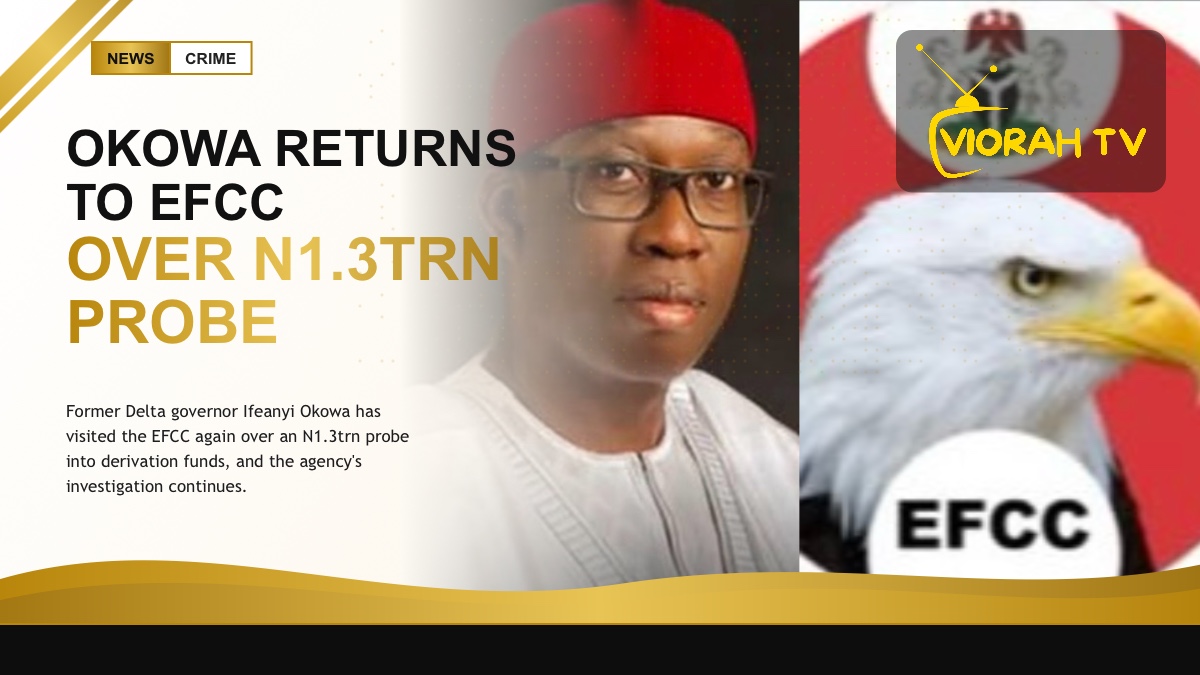
Former Delta State governor Ifeanyi Okowa has returned to the Economic and Financial Crimes Commission over an N1.3trn probe, visiting the agency’s Lagos office on Monday. The Okowa EFCC probe centres on the alleged diversion of derivation funds during his eight years in power.
What the Okowa EFCC probe covers
Investigators are examining the alleged diversion of about N1.3trn from the 13 per cent derivation funds allocated to Delta State from the Federation Account between 2015 and 2023. The derivation funds are paid to oil-producing states and are meant to support development in communities affected by extraction. The agency is seeking to establish how the money was spent.
Okowa, who governed Delta from 2015 to 2023, was first arrested in connection with the matter in late 2024. He has been linked to allegations involving the acquisition of properties in Asaba and Abuja, claims he is entitled to contest. The commission has said its inquiry is continuing despite his political moves.
Monday’s visit
The former governor attended the commission’s directorate office on Awolowo Road, Ikoyi. According to accounts of the visit, he sought the return of his international passport, reportedly telling officials he needed to travel abroad for medical treatment. It was not confirmed whether the request was granted.
Okowa has previously said he knows those behind the investigation, framing it in political terms. The EFCC, for its part, has stated that the case remains active regardless of his party affiliation. Viorah TV is reporting the development without taking any position on the allegations, which are yet to be tested in court.
A continuing inquiry
The commission has not announced charges in the matter, and an investigation does not amount to a finding of wrongdoing. Under Nigerian law, anyone accused remains presumed innocent unless and until convicted by a court. The agency typically files charges only after concluding its review of documents and statements.
Cases involving large sums and former office holders often take time, with multiple invitations, statements and reviews before any decision on prosecution. The presence of a former governor at the agency’s office signals that the file remains open, but it does not, on its own, indicate the direction of the inquiry.
Why the case draws attention
Derivation funds are a sensitive subject in oil-producing states, where residents frequently complain that wealth from their land has not translated into roads, schools and clinics. Scrutiny of how those funds were managed therefore resonates beyond Delta, touching a wider debate about accountability for public money.
The outcome of the case will be watched closely by observers of Nigeria’s anti-graft efforts. For now, the facts in the public domain are limited to the agency’s stated focus and the former governor’s visits and denials. Viorah TV will continue to follow the matter as it develops, reporting verified facts only.
High-profile probes of this kind also feed a wider national conversation about how state resources are managed and how those entrusted with public funds are held to account. Supporters of robust enforcement argue that scrutiny deters misconduct, while critics caution against trial by headline before the courts have weighed any evidence. Both views point to the same need for due process, in which allegations are tested fairly and a verdict rests on facts established in a courtroom rather than on speculation.

