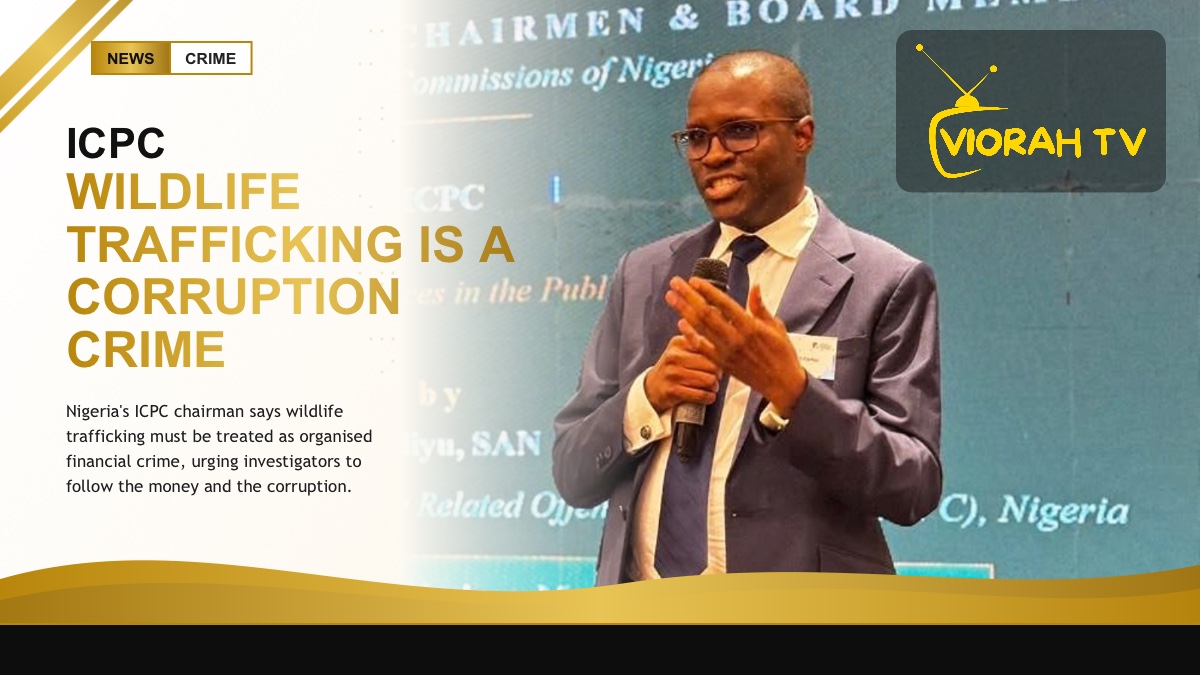
Nigeria’s anti-corruption chief says wildlife trafficking must be treated as organised financial crime, not merely a conservation problem. The chairman of the Independent Corrupt Practices and Other Related Offences Commission, Musa Adamu Aliyu, made the call at a major United Nations crime forum in Vienna.
Why ICPC sees wildlife trafficking as corruption
Addressing delegates at the 35th Session of the Commission on Crime Prevention and Criminal Justice, the chairman argued that the illegal wildlife trade is sustained by corruption at its core. He said tackling it requires the same tools used against money laundering and terrorism financing, rather than approaches limited to protecting animals.
His central message was that the trade does not survive on poaching alone. It relies on bribed officials, falsified documents and hidden money flows that move illegal goods across borders. Treating it as a financial crime, he said, exposes the networks that keep it running.
A new unit and a clear strategy
In a notable policy announcement, the chairman revealed that the commission has set up a dedicated unit focused on environmental crime investigations. He framed it as a decision to give environmental offences the same priority long reserved for the most serious financial crimes, signalling a shift in how Nigeria approaches the problem.
He outlined a three-part strategy for effective cases. Investigators, he said, must target the product, meaning the physical illicit goods; the money, through asset tracing and analysis of suspicious transactions; and the corruption enablers, the officials and systems that allow the trade to flourish. Pursuing all three at once, he argued, is the only way to dismantle the networks.
Part of a bigger fight
The intervention fits the commission’s wider concern about illicit financial flows draining the continent. Its leadership has warned that Africa loses tens of billions of dollars each year to such flows, money that could otherwise fund development. Linking environmental crime to that drain places it within a broader campaign to protect public resources.
Nigeria has featured in international reports as a transit point for trafficked wildlife products, including ivory and pangolin scales destined for foreign markets. Stronger enforcement at home, backed by cooperation abroad, is seen as essential to closing the routes that smugglers exploit.
Why the approach matters
Conservation groups have long argued that seizing shipments is not enough if the financiers and protectors behind them remain untouched. By reframing wildlife trafficking as a corruption and money problem, the commission aligns Nigeria with a growing global view that the trade should be fought like any other transnational crime ring.
The real test will be in the casework that follows. Setting up a unit and announcing a strategy are first steps; securing convictions that reach the enablers will show whether the tougher stance has teeth. For now, the message from Vienna was that Nigeria intends to chase the money and the corruption, not just the contraband.
The country’s rich biodiversity, including elephants and pangolins, has made it both a source and a transit hub for trafficked species. Tackling that trade matters not only for the animals but for national security, since the same smuggling routes and bribery networks often carry other illicit goods. Cutting them serves a broader fight against organised crime.
By taking its message to a global stage, the commission also signalled that Nigeria wants to be seen as a serious partner in international efforts against environmental crime. Cross-border cooperation, shared intelligence and joint operations are central to stopping a trade that respects no national boundary. Whether the new approach delivers results at home will determine how much weight those words carry abroad.

