Table of Contents
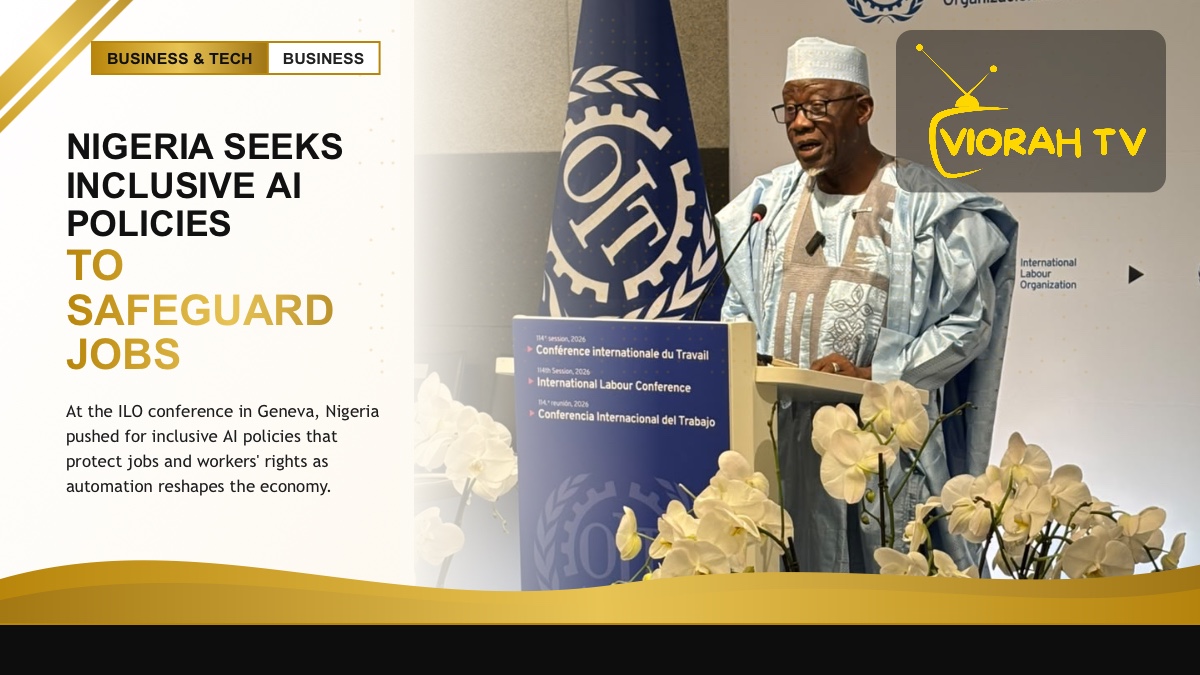
Nigeria has called for inclusive AI policies that protect jobs and workers’ rights even as artificial intelligence reshapes the global economy.
The Gist
- Nigeria pushes inclusive AI policies at ILO
- Aims to protect jobs and workers’ rights
- Raised at Geneva labour conference
The appeal came at the 114th Session of the International Labour Conference in Geneva, Switzerland.
Nigeria pushes inclusive AI policies
Minister of Labour and Employment Muhammad Maigari Dingyadi delivered Nigeria’s statement. He argued that AI must serve people, not replace them.
Dingyadi said the benefits of the technology should not come at the expense of decent work and social justice. He pushed for a human-centred model of adoption.
The minister welcomed ILO discussions on protecting workers in new forms of employment. He stressed the need for clear standards as the world of work changes.
Focus on platform and gig workers
Nigeria highlighted the treatment of platform workers and the wider gig economy. These workers often fall outside traditional labour protections.
Ride-hailing drivers, delivery riders and online freelancers have grown into a large workforce. Many lack contracts, benefits or job security.
Dingyadi said appropriate labour standards are needed to shield such workers as AI tools spread across these sectors.
Why automation worries policymakers
AI is already automating tasks across customer service, logistics and data work. That raises fears of job losses in economies with high unemployment.
For Nigeria, where millions of young people seek work each year, the stakes are high. Poorly managed automation could deepen joblessness.
But the same tools also create openings in tech, services and new digital industries. The challenge is steering the shift so workers are not left behind.
Balancing risk and opportunity
Nigeria’s tech sector has grown rapidly, with startups, fintechs and digital services creating new kinds of jobs.
AI tools could boost productivity in these industries if workers are trained to use them well.
But the same tools can displace routine roles, raising the stakes for clear national policy.
Officials say reskilling programmes will be essential to help workers adapt to changing demands.
Education systems may also need to evolve, equipping young people with digital and analytical skills.
The ILO has urged member states to put people at the centre of AI adoption rather than chase efficiency alone.
Trade unions have a stake in how the rules are written, given the impact on members.
Employers, for their part, want flexibility to adopt tools that cut costs.
Bridging those interests is part of the ILO’s mandate at gatherings like this.
Nigeria’s delegation framed cooperation, not confrontation, as the way forward.
Concrete outcomes will depend on national follow-up long after the conference ends.
For now, the country has staked out a clear, worker-friendly position.
Why it matters
The conference theme captured the moment: harnessing artificial intelligence for decent work. Governments worldwide are racing to write rules before the technology outpaces them.
Nigeria’s position aligns it with countries that want guardrails rather than a free-for-all. The aim is to capture AI’s gains while limiting harm to livelihoods.
Turning statements into action will be the real test. That means training programmes, updated labour laws and protections for the growing gig workforce.
For Nigerian workers, the debate is not abstract. How the country manages AI in the coming years could shape the jobs available to the next generation.
Source: ILO