Table of Contents
Cosmas Maduka built one of Nigeria’s most respected business empires from N300, turning a single spare-parts venture into the Coscharis Group, a conglomerate valued at about $500 million. His story has resurfaced this week as the Nnewi-born entrepreneur reflected publicly on faith, grit and the long climb from poverty to wealth.
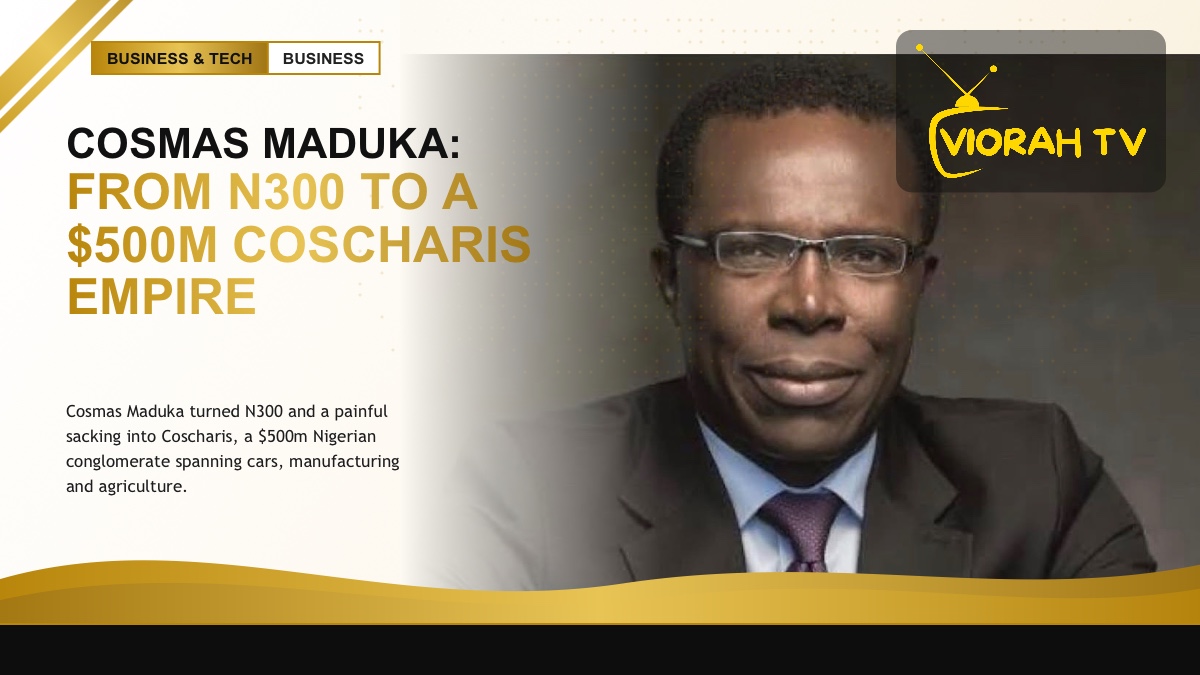
Who is Cosmas Maduka?
Born in Jos to parents from Nnewi in Anambra State, Maduka lost his father at the age of six. He dropped out of primary school and hawked akara, the fried bean cake sold on Nigerian streets, to help his widowed mother make ends meet. As a teenager he moved into a relative’s home to learn the motor spare-parts trade under the classic Igbo apprenticeship system known as igba boi.
That apprenticeship ended bitterly. Maduka has said he was wrongly dismissed by his uncle and handed only N200 after years of service. Rather than give up, he used the little he had to start again, partnering briefly on a venture called CosDave before striking out on his own.
How Coscharis started with N300
With about N300 in capital, Maduka founded Coscharis Motors, a name that fuses his own with that of his wife, Charity, whom he married at 21. The young firm traded in automobile spare parts, slowly building trust with customers and suppliers. Maduka has often credited discipline, honesty and his Christian faith for keeping the business alive through its lean early years.
The turning point came in 1982, when the Federal Government issued import licences to a small group of motor companies and Coscharis was selected. The licence allowed the company to import vehicles directly and scale far beyond a roadside spare-parts stall.
What the Coscharis Group looks like today
Today the Coscharis Group is a diversified conglomerate estimated to be worth around $500 million. Its interests span automobile sales and servicing, manufacturing, information technology, petrochemicals, auto components and agriculture. Coscharis Motors remains its best-known arm, distributing luxury brands such as Range Rover, Jaguar and Ford.
In 2015 the company became the sole distributor of BMW in Nigeria. It also built an assembly plant for the Ford Ranger, positioning itself within the country’s slow push toward local vehicle assembly. The group now employs thousands of Nigerians across its subsidiaries.
Why his story matters
Maduka’s journey is held up as proof that Nigerian enterprise can grow from almost nothing. He has used recent interviews to argue that education alone does not guarantee wealth, that young people should not rely solely on salaried jobs, and that government policy must do more to let businesses thrive. He has also called for a South-East seaport to ease the region’s dependence on the Lagos ports.
His critics note that the breakthrough rode on a government import licence, a reminder that policy access still shapes who succeeds in Nigeria’s economy. Even so, the akara hawker who became a billionaire industrialist remains one of the country’s most cited rags-to-riches examples, and a fixture on lists of its wealthiest self-made entrepreneurs.
Lessons from his rise
Business writers often point to three threads in Cosmas Maduka’s career: an early willingness to start small, a refusal to let setbacks end the journey, and a long-term view that favoured reinvestment over quick spending. He has spoken about turning down easy profits to keep funding expansion, and about treating customers and staff as partners in growth. Those habits, he argues, matter more than any single lucky break, and they are the part of his story he most wants young Nigerians to copy.

