Table of Contents
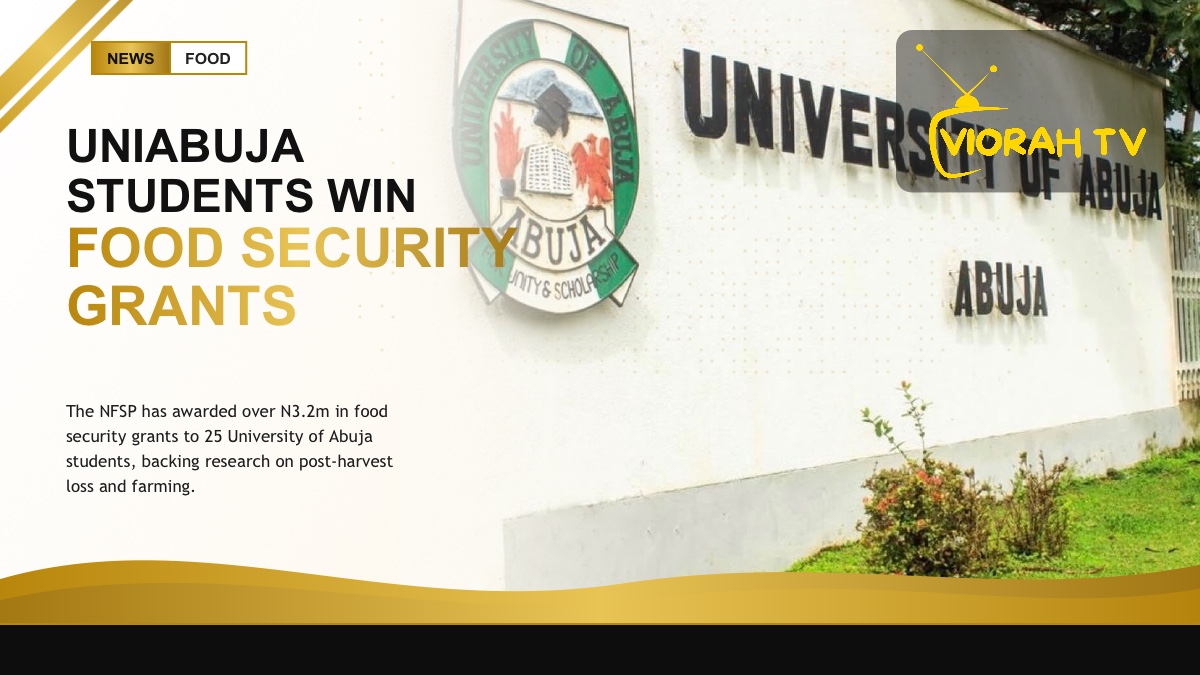
Twenty-five University of Abuja students have won food security grants worth over N3.2 million to fund research aimed at tackling Nigeria’s food challenges. The Nigerian Food Security Project, NFSP, awarded the grants to final-year students in the Faculty of Agriculture, backing practical work that could help the country grow and keep more of its food.
What the food security grants support
The research grants, totalling N3,211,500, are designed to support research-driven solutions to Nigeria’s food security challenges. They target work in areas such as food security, agricultural supply chains, climate resilience, post-harvest loss reduction and sustainable food systems. The aim is to turn academic study into ideas that can be applied on farms and in markets.
The 25 selected students will receive support to work on issues including women and youth participation in agriculture and the reduction of post-harvest losses. Those losses, when crops spoil between harvest and market, are a major drain on Nigeria’s food supply and farmers’ incomes.
Linking research to real problems
The Executive Director of NFSP, Ajibola Oladiipo, said the initiative is meant to ensure that research from higher institutions directly contributes to solving food security challenges. The goal is to bridge the gap between universities and the everyday realities of farming, storage and distribution that shape what reaches Nigerian tables.
By funding students at the start of their careers, the programme also nurtures a new generation of agricultural researchers. Encouraging young people, including women, to engage with farming and food systems addresses a long-standing concern that agriculture is ageing and struggling to attract fresh talent.
Why food security is a national priority
Nigeria faces persistent pressure on food supply, with high prices, inflation and insecurity all weighing on access to affordable meals. Boosting local production and cutting waste are central to easing that strain. Research into better storage, supply chains and resilient farming can deliver gains that ripple far beyond the laboratory.
Post-harvest loss is a particularly stubborn problem. Significant volumes of food are lost each year because of poor storage, weak transport links and limited processing. Tackling those losses can effectively increase the food available without a single extra hectare being farmed, making it one of the most cost-effective routes to greater security.
Initiatives that connect classrooms to fields are increasingly seen as vital. When students study real problems and propose workable solutions, their findings can inform policy, guide investment and improve practices among farmers and traders. The challenge is ensuring that promising research is supported beyond a single grant cycle.
For the students, the awards are both recognition and responsibility, a chance to contribute to a national priority while building their own careers. For Nigeria, every advance in producing and preserving food helps in the wider effort to feed a fast-growing population.
The grants also send a signal to other institutions and funders that targeted support for student research can pay dividends. If similar schemes spread across more universities, the cumulative effect on Nigeria’s farming and food systems could be significant.
Programmes like this, modest in scale but focused in aim, form part of the broader push to strengthen Nigeria’s food systems from the ground up.

