Table of Contents
A Plateau attack has killed at least 20 people in Kawel community, Bokkos area of Plateau State, after an armed group stormed the village and later exchanged gunfire with police. Officers arrived as the assault unfolded and forced the attackers to retreat, but no arrests have been confirmed.
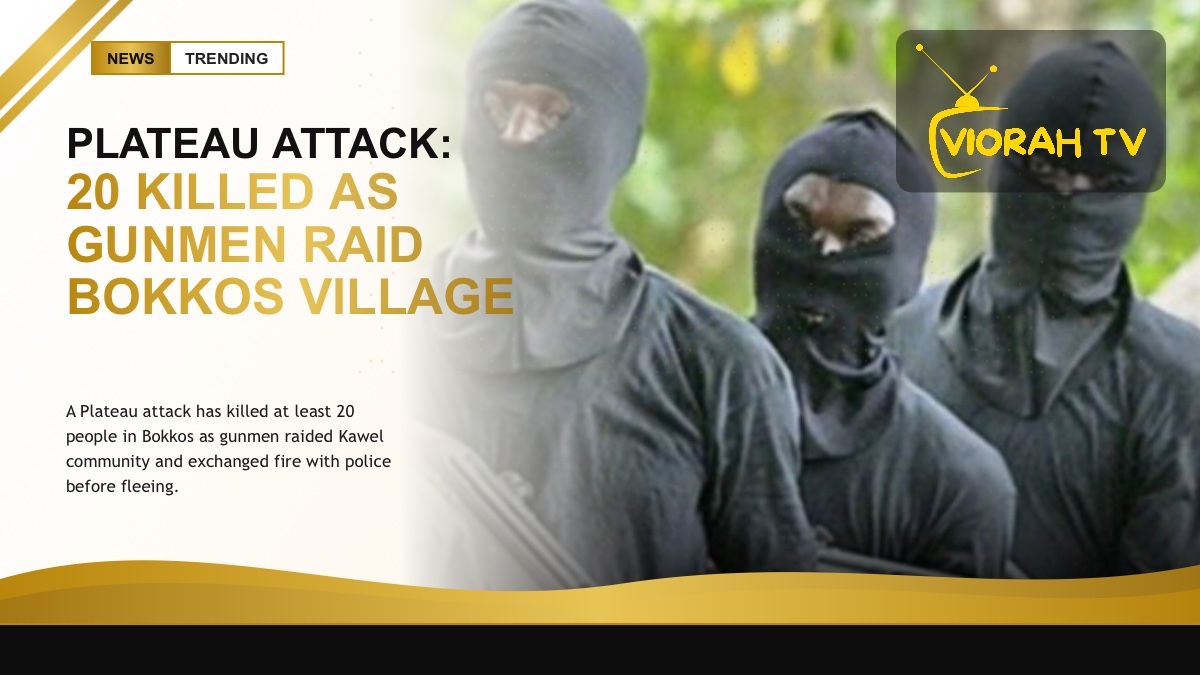
What happened in the Plateau attack
The assailants descended on the quiet farming settlement on Sunday, opening fire on residents before security forces responded. Police engaged the gunmen in a firefight that eventually pushed them back into surrounding bushland. As of this report, no group has claimed responsibility and the motive remains unclear.
Bokkos sits in a region of central Nigeria that has endured repeated waves of violence over the past decade. Clashes between farming communities and armed herders, reprisal raids and banditry have left thousands dead across Plateau and neighbouring states, displacing whole villages and straining trust in the authorities.
Government and security response
Plateau State Governor Caleb Mutfwang directed the state’s emergency management and humanitarian agencies to provide immediate relief to victims and their families. Officials promised shelter, food and medical care for survivors, many of whom fled into the night as the shooting spread.
Security agencies say investigations have begun, and patrols have been stepped up around Bokkos to prevent a follow-up raid. Community leaders, however, have repeatedly warned that response times remain slow and that attackers often strike isolated hamlets with little resistance before help arrives.
A pattern of bloodshed
This latest assault fits a grim pattern. Plateau, part of Nigeria’s volatile Middle Belt, lies along the fault line where the largely Muslim north meets the predominantly Christian south. Competition over land, water and grazing routes, worsened by climate pressure and a flood of small arms, has fuelled cycles of attack and revenge.
Rights groups have urged the federal government to move beyond condolences and confront the root causes: unchecked weapons, weak rural policing and a justice system that rarely convicts perpetrators. Residents say the absence of prosecutions emboldens gunmen to return.
Why it matters
Each Plateau attack deepens a humanitarian crisis that has uprooted farming families, wrecked harvests and pushed communities into camps for the displaced. Persistent insecurity in the food-producing Middle Belt also threatens Nigeria’s wider battle against hunger and rising food prices.
For Bokkos, the immediate need is safety. Survivors want guarantees that they can return to their farms without fear, and that those behind the killing will finally be caught and prosecuted. Until then, the cycle that has scarred Plateau for years looks set to continue.
Communities demand lasting protection
Local leaders in Bokkos say temporary patrols are not enough. After each raid, soldiers and police are deployed for a time, only to thin out once public attention fades, leaving villages exposed again. Residents are calling for permanent security posts, better intelligence gathering and quicker emergency lines so that warnings of an impending attack reach officers before gunmen strike.
Aid agencies operating in the area have also raised concern about the toll on children, many of whom have witnessed killings or lost relatives. Trauma counselling, school support and food assistance, they argue, must accompany any security response if displaced families are to rebuild their lives. Without that broader support, experts warn, the cycle of violence and displacement will keep repeating across the Middle Belt.
Viorah TV will follow the official investigation and update this story as the police and state government release further details on casualties and arrests.

