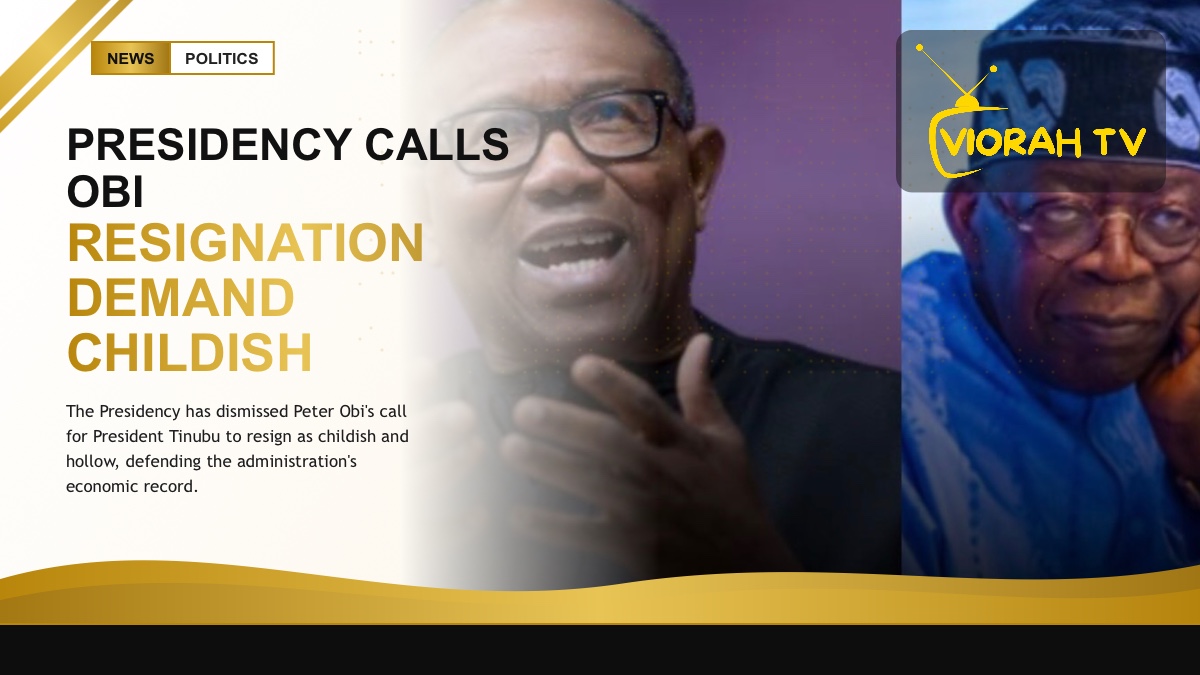
The Presidency has dismissed a call by Peter Obi for President Bola Tinubu to resign, describing the demand as childish and hollow. Officials said the appeal was an unwarranted distraction from efforts to address the country’s economic and security challenges.
How the Presidency answered Peter Obi
Special Adviser to the President on Information and Strategy, Bayo Onanuga, led the response. He argued that the opposition figure’s comparison of Nigeria with the United Kingdom, and his reference to a British prime minister’s voluntary resignation, reflected a misunderstanding of Nigeria’s presidential system of government.
Onanuga stressed that the president was elected for a fixed four-year term and could not be pressured out of office through social media campaigns or political rhetoric. He framed the resignation demand as anti-democratic, insisting that the constitution, not online pressure, sets the terms of a president’s tenure.
Defending the record
The Presidency also pushed back on the criticism of the economy. It said the former Anambra State governor had ignored indicators it presented as signs of improvement since the administration took office in May 2023. Among them, officials cited quarterly GDP growth, rising foreign reserves, higher oil production and gains in the stock market.
By pointing to those figures, the government sought to reframe the debate around progress rather than hardship. Critics of the administration, however, continue to highlight the cost-of-living squeeze felt by many households, and the exchange reflects a broader argument over how to read Nigeria’s economic direction.
The political backdrop
The clash is the latest in a running series of disputes between the government and the opposition figure, who remains one of the most prominent voices challenging the administration. Such exchanges are increasingly common as attention turns toward the politics of the years ahead and the positioning of rival camps.
Statements like the resignation call and the sharp official reply are part of the ordinary back-and-forth of democratic debate. Viorah TV is reporting the comments from both sides without taking a position, leaving readers to weigh the competing claims about the economy and governance.
Why it matters
Public arguments between senior political figures shape the national conversation and signal the fault lines that will define future contests. They also test how institutions and the public respond to calls for accountability, and how leaders defend their stewardship of the economy and security.
For now, the president remains in office and the administration has rejected the demand outright. The episode underscores the intensity of Nigeria’s political discourse, where economic data and democratic norms are both invoked in the contest for public opinion. Viorah TV will continue to report the facts as they emerge.
Analysts note that such exchanges tend to energise both camps, giving the government a chance to defend its record and the opposition a platform to keep its concerns in the headlines. Ordinary Nigerians, meanwhile, are left to judge the claims against their own daily experience of prices, jobs and security. That gap between official figures and lived reality often shapes how these disputes land, and it is likely to remain a defining theme as political competition sharpens in the months ahead.

