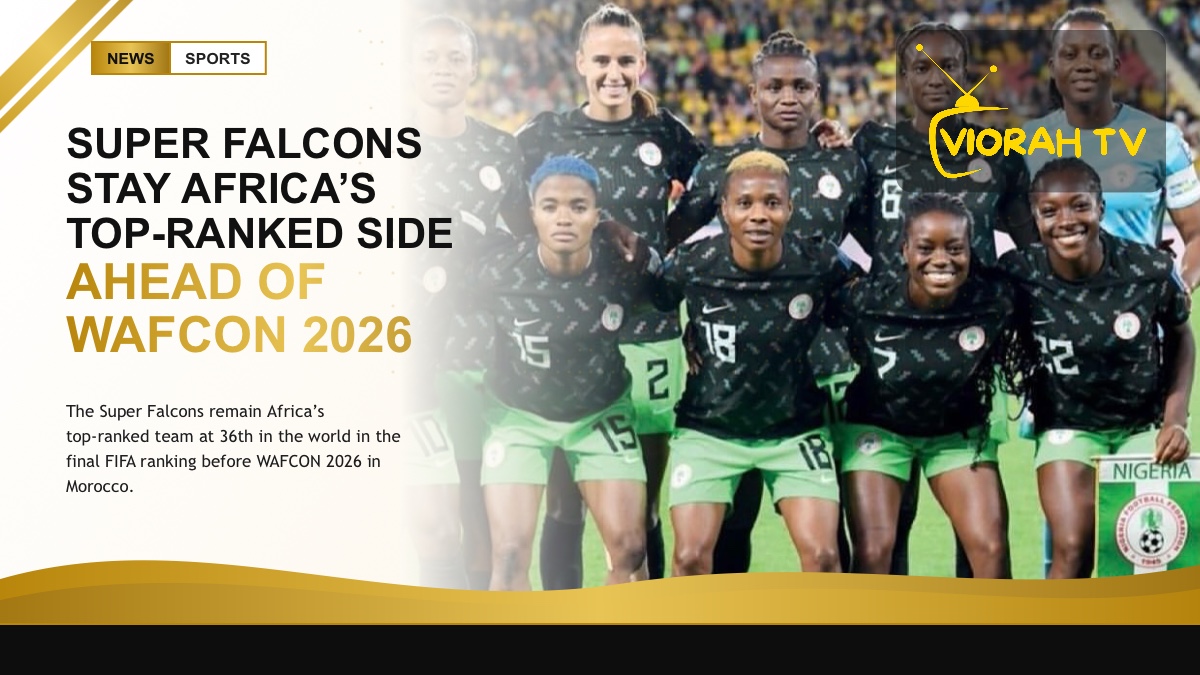
The Super Falcons will head into the 2026 Women’s Africa Cup of Nations as Africa’s top-ranked side after holding their 36th position in the latest FIFA Women’s World Ranking. It is the final FIFA update before the continental showpiece begins.
Steady at the summit
Despite back-to-back friendly wins over Senegal earlier in June — a 2-1 victory on June 5 followed by a 3-0 win three days later — the reigning champions could not climb higher globally, remaining behind Serbia, Ukraine and the Czech Republic. They stay comfortably ahead of sides such as Vietnam, Slovenia, the Philippines and Jamaica.
The results showed both attacking sharpness and defensive control, even if they were not enough to lift Nigeria in the global standings. Consistency, rather than dramatic movement, has defined the team’s recent ranking history.
Clear of their continental rivals
Nigeria remain the highest-ranked African nation by a wide margin. South Africa are their closest challengers at 57th, followed by Ghana at 60th and hosts Morocco at 64th. Zambia, a group-stage opponent, sit at 65th, underlining the gap between the Falcons and the chasing pack.
A favourable-looking group
The Super Falcons have been drawn in Group C alongside Zambia, Egypt and Malawi, ranked 99th and 158th respectively. The expanded 16-team tournament runs from July 25 to August 16 in Morocco, and the competition will also help decide Africa’s representatives for the 2027 FIFA Women’s World Cup in Brazil.
Reaching the semi-finals would secure World Cup qualification, giving Nigeria a clear target beyond simply progressing from the group.
The global picture
At the top of the world rankings, Spain remain number one, followed by the United States, Germany, England and Japan. Nigeria’s steady place in the mid-30s reflects years of stability, with the Falcons among the few African sides to sit consistently inside the global top 40.
Chasing more history
Nigeria go to Morocco as Africa’s most successful women’s side, targeting yet another continental crown. With experienced leaders and a deep talent pool, Rasheedat Ajibade and her teammates will be expected to challenge for the title once again, even as rivals such as South Africa and Morocco continue to close the gap on the continent.
The friendly wins over Senegal offered useful preparation, allowing the coaching staff to test combinations and sharpen form ahead of the tournament.
With a deep pool of European-based professionals to call on, Nigeria will fancy their chances of going deep in Morocco, though the expanded field promises stiffer competition than ever.

