Table of Contents
President Bola Tinubu says roads are the foundation of a knowledge economy, arguing that education, justice and innovation cannot thrive without the physical links that connect people and ideas. He made the point in Abuja while launching a new road in the city’s research and institutional district.
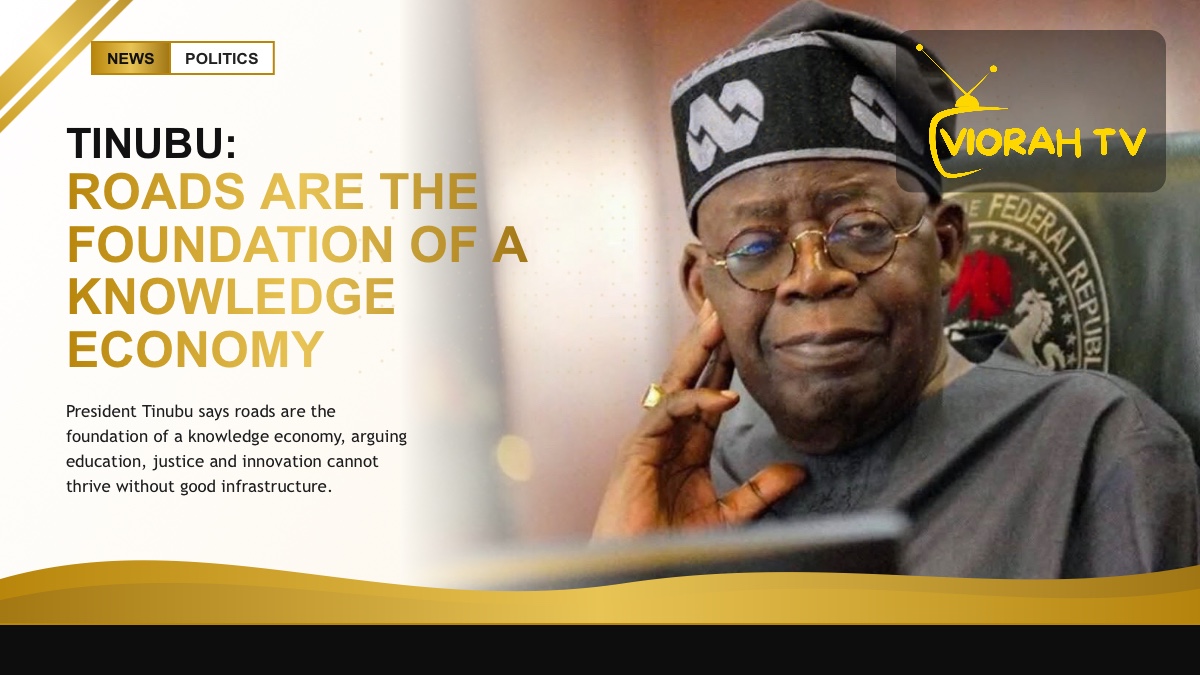
What Tinubu said about the knowledge economy
Speaking at the inauguration of the construction of Collector Road CO1, running from Nile University toward Ring Road III, the President said his administration is building infrastructure to lay the foundation for a knowledge-driven economy. He stressed that ideas cannot move if roads do not move, and that good roads connect the heart and people together.
The road sits in an institutional research district that houses universities and knowledge-focused institutions, which the President used to frame his wider argument: that schools, courts and innovators all depend on reliable physical infrastructure to function and grow.
Part of a bigger infrastructure push
The Abuja project is one piece of a national infrastructure drive. Larger schemes include the Lagos-Calabar Coastal Highway, a long road project crossing several coastal states, and the Sokoto-Badagry Super Highway, both pitched as economic corridors meant to link ports, industries and producing regions.
The administration has tied those projects to an ambition of building a much larger economy through strategic infrastructure spending. Officials argue that better roads and rail cut the cost of moving goods, people and services, which in turn supports trade and investment.
Why roads and the knowledge economy connect
A knowledge economy depends on the easy flow of people and information, from students reaching campuses to researchers reaching laboratories and entrepreneurs reaching markets. The President’s case is that none of that movement happens efficiently on broken or missing roads.
By placing the new road inside a research district, the government signalled that it views transport links and intellectual capital as parts of the same system. Reliable roads, in this view, are not separate from education and innovation but a precondition for them.
The debate around the spending
Big infrastructure projects in Nigeria draw both praise and scrutiny. Supporters say roads, rail and corridors are overdue investments that will unlock growth for years. Critics question costs, timelines and how projects are financed at a time when many households face economic pressure.
The choice of venue carried its own message. The new road runs through an institutional research district that is meant to cluster universities, agencies and innovation hubs in one part of the capital. By improving access to that zone, the government argues it is making it easier for students, staff and investors to reach the very institutions a knowledge economy depends on.
The wider plan ties Abuja’s local roads to national corridors stretching across several states. Supporters say connecting campuses, courts, markets and ports through better transport will lower costs and spread opportunity beyond the big cities. The test, as with any major public works, will be delivery: completing the roads on schedule and keeping them in good condition long after the ribbon-cutting.
For now, the President is presenting roads as the groundwork for the kind of economy Nigeria says it wants to build, one driven by ideas, skills and innovation. Whether the corridors deliver the promised returns will depend on how quickly they are completed and how well they are maintained once the launches are over.

